History & Origins
The complete story of how a group of MIT students turned a $120,000 minicomputer into the birthplace of video gaming.
The Setting: MIT in 1961
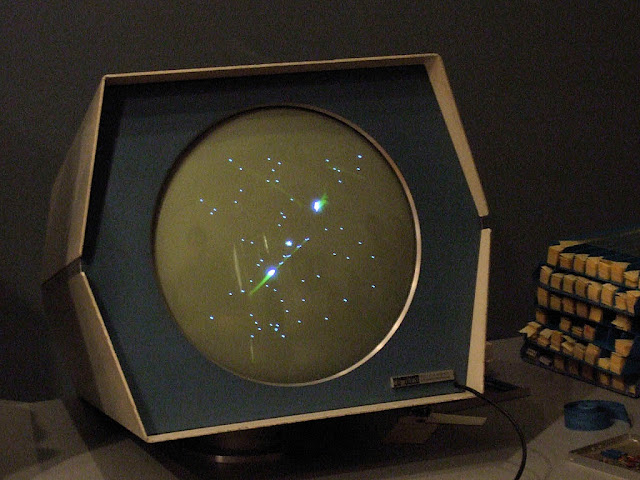
In the summer of 1961, the Massachusetts Institute of Technology received a donation that would change the course of entertainment history: a Digital Equipment Corporation PDP-1 minicomputer. Donated by DEC founder Ken Olsen, the PDP-1 was one of the first commercially available interactive computers — and it came with a Type 30 CRT display capable of rendering vector graphics in real time.
The PDP-1 was installed in MIT's Building 26, home to the university's electrical engineering department. Unlike the massive, batch-processing mainframes of the era, the PDP-1 was designed for real-time interaction — a single user could sit at its console and see the results of their programming immediately on the CRT. This was radical for 1961, and it attracted a community of brilliant, curious students who would come to be known as the Tech Model Railroad Club (TMRC) and the broader MIT hacker culture.
💻 The PDP-1 by the Numbers
| Specification | Value |
|---|---|
| Release Year | 1959 (first delivery 1960) |
| Price | $120,000 (equivalent to ~$1.2M today) |
| Word Size | 18 bits |
| Memory | 4K words (expandable to 64K) |
| Clock Speed | ~100 kHz (5–10 microseconds per instruction) |
| Display | Type 30 CRT, 1024×1024 vector resolution |
| Input | Front panel switches, paper tape reader, control boxes |
The Creators
Spacewar! was not the work of a single genius in isolation — it was a collaborative effort by several MIT students and researchers, each contributing key elements to the final game.
Steve "Slug" Russell
Lead Developer
A graduate student in mathematics and computer science, Russell wrote the core code for Spacewar! in late 1961 and early 1962. He was inspired by E.E. "Doc" Smith's Lensman space opera novels and the visual possibilities of the PDP-1's CRT.
Martin Graetz
Co-Designer
A fellow MIT student who contributed to the game's design and concept. Graetz later wrote one of the definitive historical accounts of Spacewar's creation, documenting the collaborative process at MIT.
Wayne Wiitanen
Co-Designer
Another MIT student involved in the early brainstorming and development. Wiitanen, Graetz, and Russell together formed the core group that conceived and implemented the game on the PDP-1.
Other contributors included Dan Edwards, who optimized the graphics routines and added the gravitational star; Peter Samson, who created the "Expensive Planetarium" starfield background; and Alan Kotok, who helped with the control boxes. The game was a true product of the MIT hacker community — built collaboratively, shared freely, and improved by anyone who had an idea.
Development Timeline
What Inspired Spacewar?
Spacewar! did not emerge from a vacuum. Several cultural and technological influences converged at MIT in 1961 to create the perfect conditions for the first video game:
📖 Doc Smith's Lensman
Steve Russell was an avid fan of E.E. "Doc" Smith's Lensman series, pulp science fiction novels featuring epic space battles between galactic civilizations. The visual imagery of spaceship duels directly inspired Spacewar's core concept.
📺 The CRT Display
The PDP-1's Type 30 CRT could draw points and lines in real time — a capability almost no other computer had at the time. The students wanted to create something that would truly demonstrate this graphical capability, and a space game with moving ships was the perfect showcase.
🛠 MIT Hacker Culture
The Tech Model Railroad Club and the broader MIT hacker ethos valued clever programming, shared knowledge, and building things just because they were cool. Spacewar! was the ultimate "hack" — a program that turned a serious research computer into an entertainment device.
🔬 Earlier Computer Games
While Spacewar! was the first widely distributed video game, earlier experiments existed: Tennis for Two (1958) on an oscilloscope, the Cathode-Ray Tube Amusement Device (1947) patent, and OXO (1952) tic-tac-toe on EDSAC. These proved computer games were possible, but none achieved Spacewar's reach or influence.
The Custom Control Boxes
Initially, Spacewar! was played using the PDP-1's front panel switches — an awkward arrangement that required players to flip toggle switches to rotate, thrust, and fire. Recognizing that this was not ideal for competitive play, MIT students Alan Kotok and others built custom control boxes that connected to the PDP-1's I/O ports.
Each control box featured:
- Rotation toggle — rotate the ship left or right
- Thrust button — accelerate forward
- Fire button — launch a torpedo
- Hyperspace button — teleport to a random location
These custom controllers were arguably the first gamepads ever built, predating the Atari 2600 joystick by 15 years. They made Spacewar! significantly more playable and contributed to its popularity at MIT and beyond.
Why Spacewar! Matters
🌟 The First "Real" Video Game
While earlier computer game experiments exist, Spacewar! was the first to:
- Be widely distributed and played across multiple institutions
- Feature real-time graphics and animation on a display
- Include physics simulation (gravity, inertia, momentum)
- Support competitive multiplayer with dedicated controls
- Directly inspire the commercial arcade industry (Atari, Computer Space)
- Establish the space combat genre that would spawn Asteroids, Star Control, Elite, and countless others
In 2007, Spacewar! was named to the Library of Congress's National Recording Registry (in the "Moving Image" category) — the first video game ever to receive this honor. In 2012, the Smithsonian American Art Museum featured Spacewar! in its "The Art of Video Games" exhibition, cementing its place as a cultural and artistic landmark.
Continue exploring the Spacewar story: